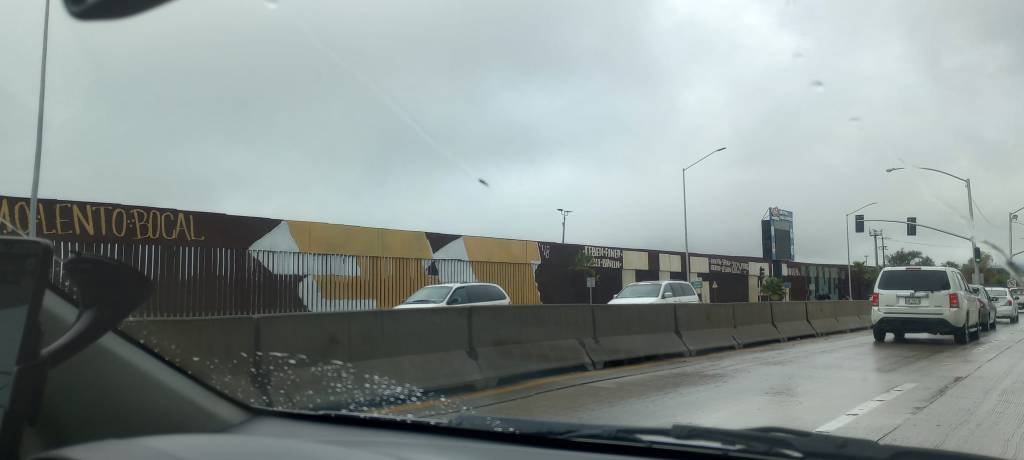
I’ve never crossed a border as strange as the one between the USA and Mexico. The frontier where we planned to cross, at Otay Mesa, east of San Diego and directly north of Tijuana, is a 6m high rusty fence which runs in a 140 mile straight line from the Pacific ocean to the border between California and Arizona. There were three crossing points where we wanted to cross – San Ysidro, Otay Mesa and the Cross Border Xpress. San Ysidro is the busiest international border crossing in the world, so we wanted to avoid that. Of the other two, the Cross Border Xpress was directly opposite Tijuana Airport and our next hire car. Unfortunately, you need to be flying from the airport to use the crossing, so we had to travel a few miles eastward, cross the border and travel a few miles back to the airport.
As it was raining very heavily – there were some serious floods in San Diego over the next couple of days – we got an Uber, which neither of us has experienced before. Our driver was a Russian who showed us his butterfly knife and told us we needed to carry a knife in Mexico for protection, but that he thought we’d be OK because we were tall and Mexicans are all short.
We crossed on foot at Otay Mesa, over an elevated enclosed footbridge. Because of the time of day and the weather, we were alone and walked through without having to queue. Before leaving the UK, we’d assiduously filled in our entry forms with our arrival and leaving dates. However, when we passed the security area, nobody seemed interested in either entry forms or passports. Our bags were briefly searched and then we were on our way. We got a taxi from the crossing to Tijuana airport, where we were introduced to Mexican driving. The rules are:
- Don’t put your seatbelt on
- Never indicate
- In traffic, drive very slowly but swerve into any lane you like at any time you like
- Try to avoid the inner (slow) lane as it’s probably full of debris
- Watch out for huge speedbumps every couple of hundred metres.
- Watch out for huge potholes everywhere (hence the swerving).
At the airport the army was out in force – jeeps with fixed machine-guns, soldiers in waterproof ponchos (very Mexican) with assault rifles poking through the side. It took a while to collect our car but once we’d got it we set off straight away; we wanted to be out of Tijuana before nightfall. In the USA, despite going for the cheapest car rental, we’d ended up with a fancy modern SUV – great for the mountains and very comfortable, but bad on fuel economy and just too big for our needs. In Mexico we got a Dodge Attitude, a cheap and cheerful compact saloon made only for the Mexican market. The main attraction for us was that it had good fuel economy (we’d be driving 1500km in it) and that it didn’t stick out and make us look like rich Americans, ripe for the Police to stop and ‘fine’ us.
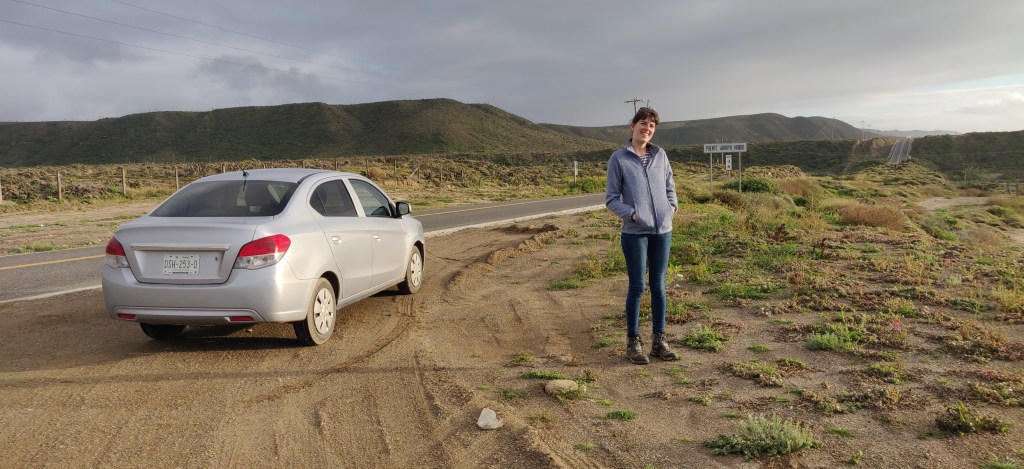
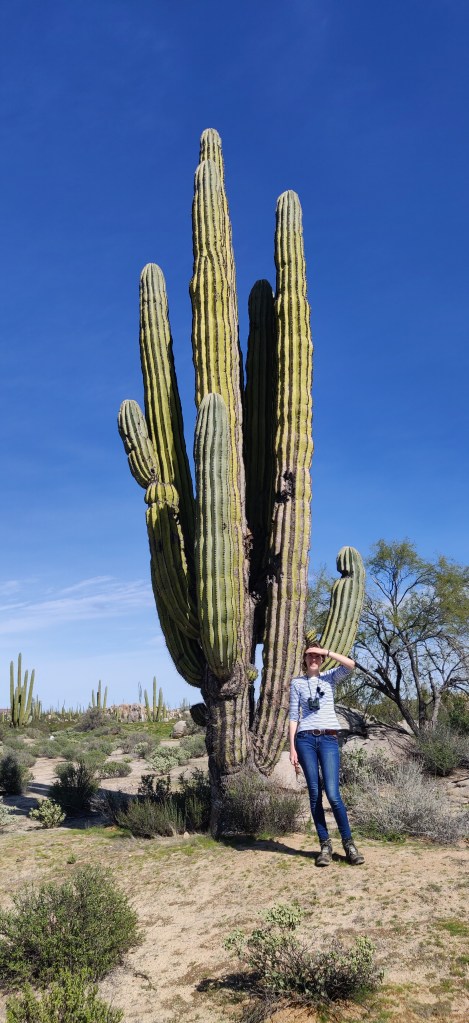
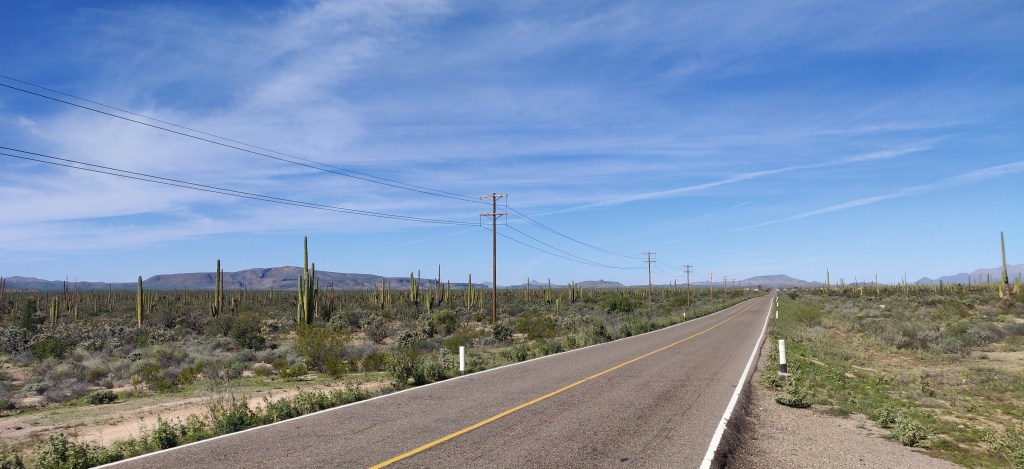
Our main objective in Mexico was to get to Guerrero Negro to see the grey whales in the lagoon of Ojo de Liebre, 700km down the coast. We were travelling through Baja (lower) California, the part of California that the USA didn’t get in 1848 after the Mexican-American war. In Mexico, Baja California is split into northern and southern states, and Guerrero Negro lies just over the border into the southern state, Baja California Sur. We spent two days driving down, staying at motels and eating out at cheap restaurants. On the second day of driving we travelled through the Baja California Desert – a proper desert with Mexican giant cactus – the type of cactus you think of when you think of cactus. It’s very sparsely populated, with 30-40 mile stretches of nothing at all and no phone signal at all. If you break down and need help, you’d have to wait for another car to pass. We saw eagles and vultures, but all the rattlesnakes and tarantulas are thankfully hiding underground at this time of year.
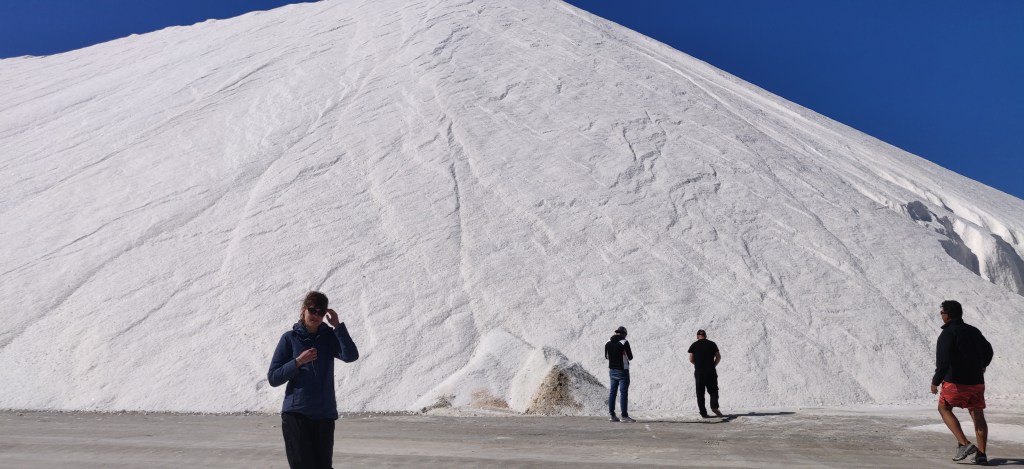
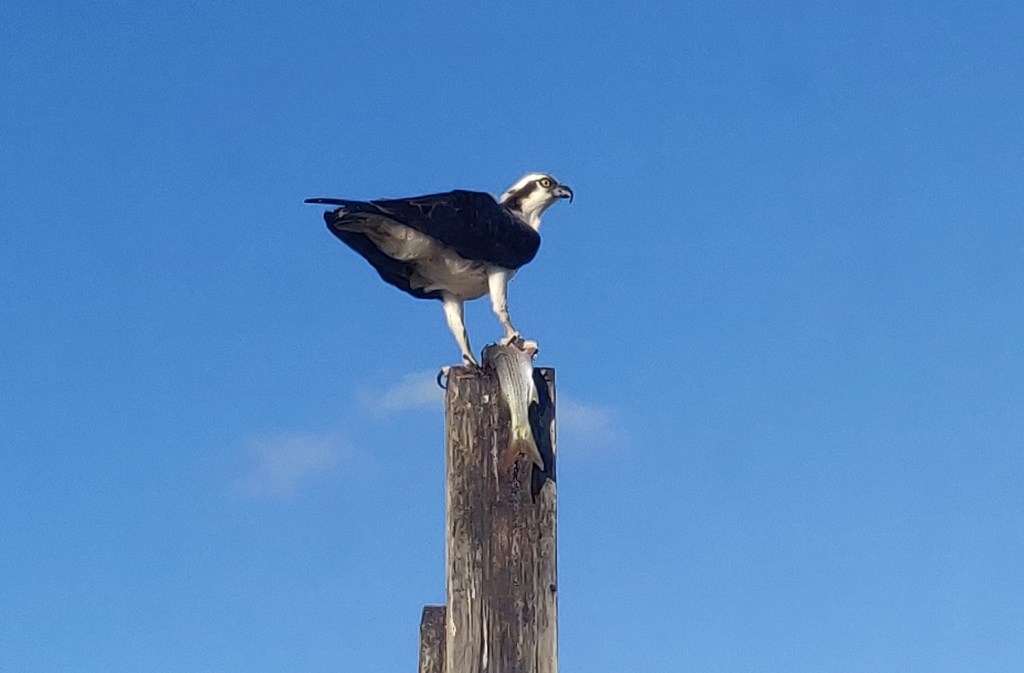
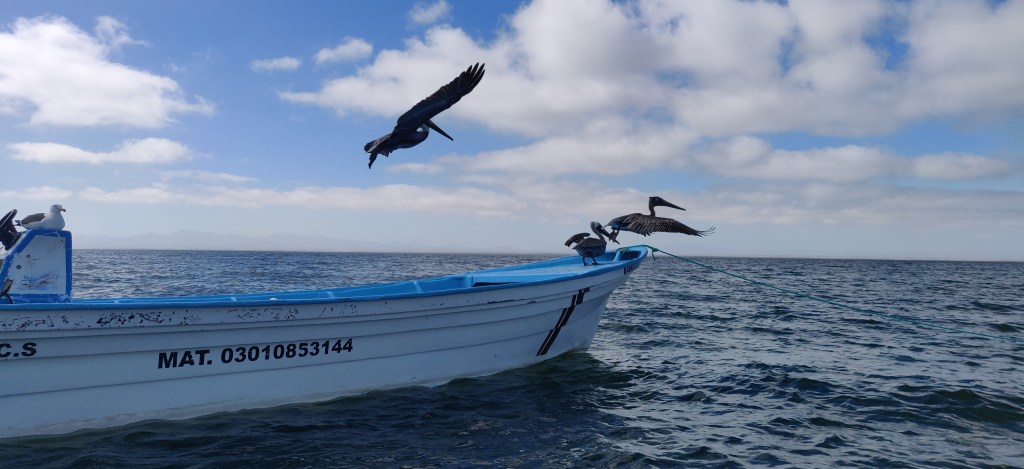
In Guerrero Negro, we had a choice of whale-watching tours, and chose to go with the one based at our hotel. At 9am we were taken down to the peninsula marina to embark on the fishing boat which would take us out into the lagoon. On the way, we travelled through the largest salt production plant in the world. The salt plant is the reason Guerrero Negro was founded, in the 1950s. It supplies salt for chemical works to countries all around the Pacific Rim. It’s a weird place to drive through, with a huge mountain of salt in the middle, looking like the top of an Alpine mountain. Apparently the mountain was worth $5,000,000. We saw lots of ospreys and pelicans on the way – the peninsular is a huge nature reserve and a world heritage site. Grey whales were hunted in Ojo de Liebre from the 1850s and rapidly driven to near extinction. It’s the only place in the world they mate and give birth, as it’s a protected location with a high salt content, so babies float to the surface easily after birth. The males guard the lagoon entrance while the females are giving birth, stopping predators like killer whales and great white sharks from entering.
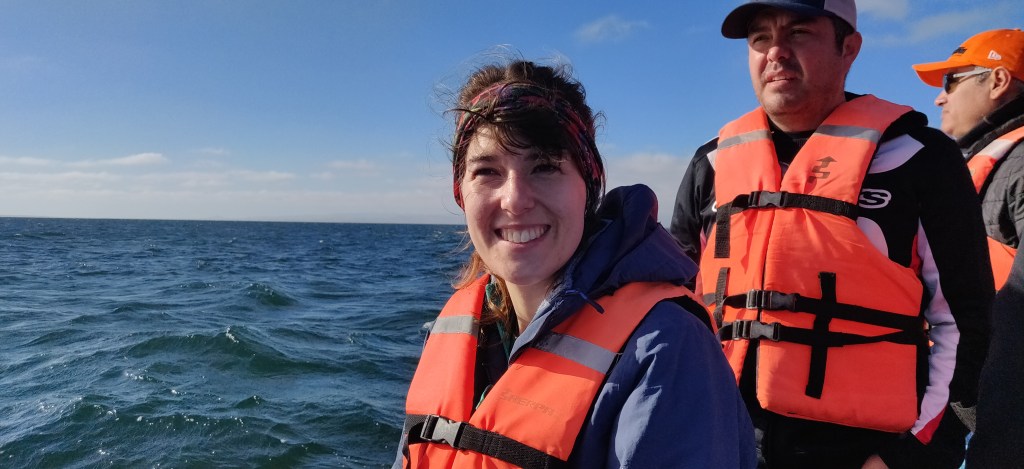
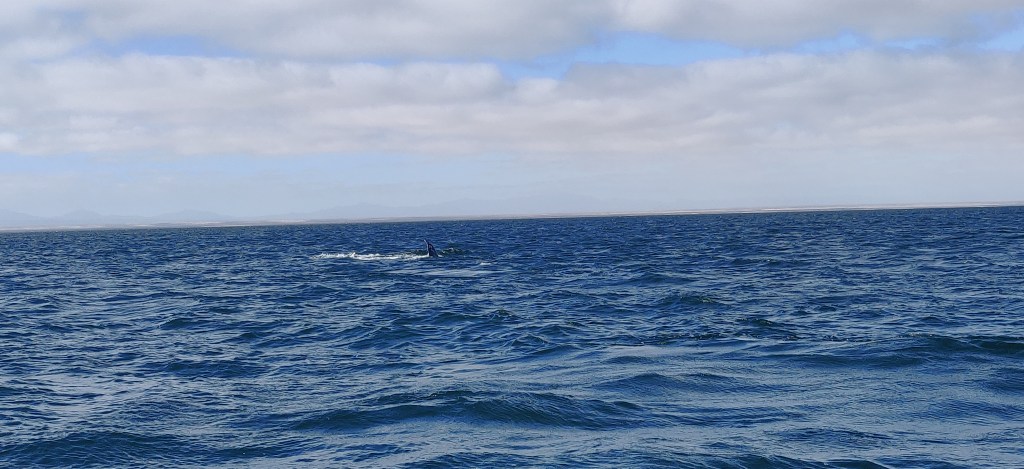
We were in a boat with one American and a group of Mexicans. Our partner boat was full of Americans, who made a lot of noise when a whale was sighted, cheering and whooping. Our boat was a bit more restrained. We saw lots of whales close up and got some good footage of a mother and calf. We had dolphins jumping within a foot of the boat, too, though no whales came right up to the boat to be touched.
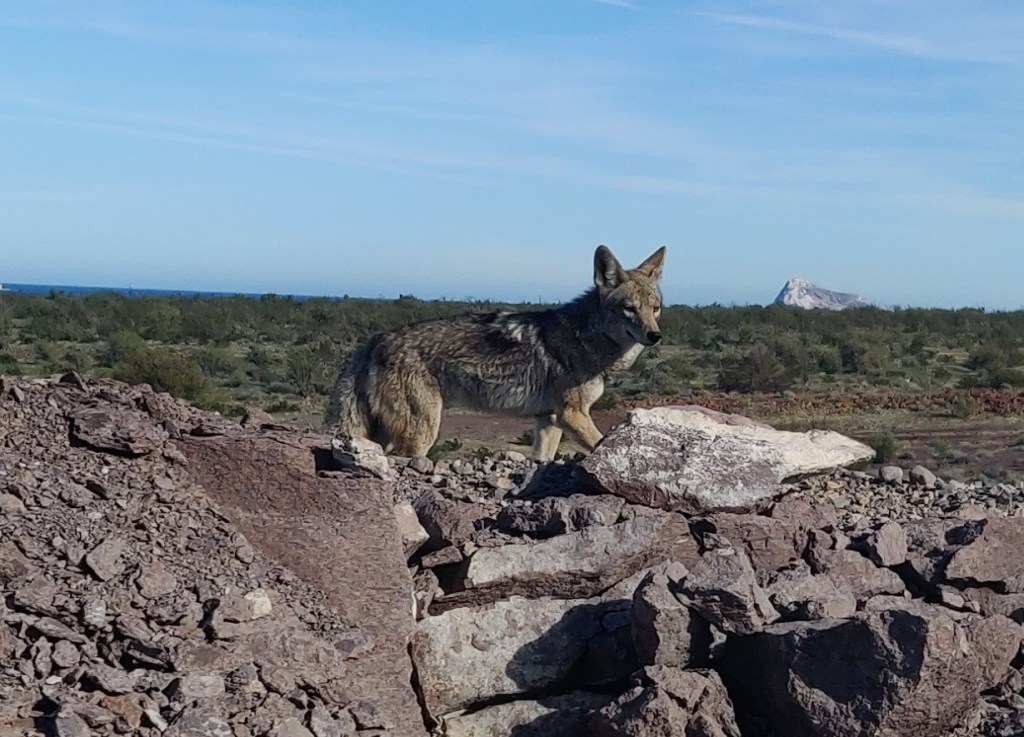
We left Guerrero Negro this morning and set off up the Eastern side of Baja California, along the coast of the Sea of Cortes – famous for its high population of Great Whites. We saw a couple of coyotes crossing the road on the way. We’ve got two more nights in Mexico before we cross the border back into the USA and spend a night before picking up our camper van for 11 days of freedom around California.
My overall impression of Mexico is generally a good one. It’s generally cheaper than the USA, which is a plus. People have tended to be more universally and genuinely friendly than in the US, though we so far only have a short time there to compare it to here. It’s a far poorer country and that’s obvious in every town we’ve passed through. You’re never far away from true slums, with people living in breeze-block buildings with no windows and roofed with tarpaulins. The roads are pretty awful, even the trunk roads – pot holes everywhere, fallen rocks from a cutting blocking two lanes of a motorway, unsurfaced roads in large areas of towns. People drive around with their cars bashed and dented, bonnets and exhausts falling off. There are stray dogs everywhere, but they’re well-treated and tend to be friendly.
We’ve passed though numerous checkpoints, both Army and Police. There’s a heavy army presence everywhere, part of Mexico’s war on the drug cartels; when driving through the desert there’ll be an ambulance with its sirens blaring escorted by two armed jeeps packed with troops. At checkpoints we’ve had the boot searched – act the gormless tourist and make sure they know you’re not from the USA and they’ll correct your Spanish and send you on your way. We’ve avoided taking photos of soldiers and checkpoints for obvious reasons.
Something we’ve noticed in both Mexico and the USA is that people tend to keep their own houses and drives very tidy and clean, but communal areas – pavements, roads, parks – aren’t afforded the same attention. The result is a place which to the outsider appears unkempt, dirty and un-cared for. There’s an exclusive feel which you don’t generally get in many countries in Europe which maybe have a greater sense of social cohesion – a sense that the community matters as much to the individual as the individual matters to the community. There’s a tendency towards gated houses and gated communities and as an outsider it can feel excluding. I’m not trying to make Europe sound like a utopia, just that there are different dominant cultural attitudes and trends, which are more or less prevalent in one place or another. The UK, as in many ways, is a mixture.
Anyway, I’m rambling. The next update will probably be when we’ve crossed the border and have our RV – internet access depending.
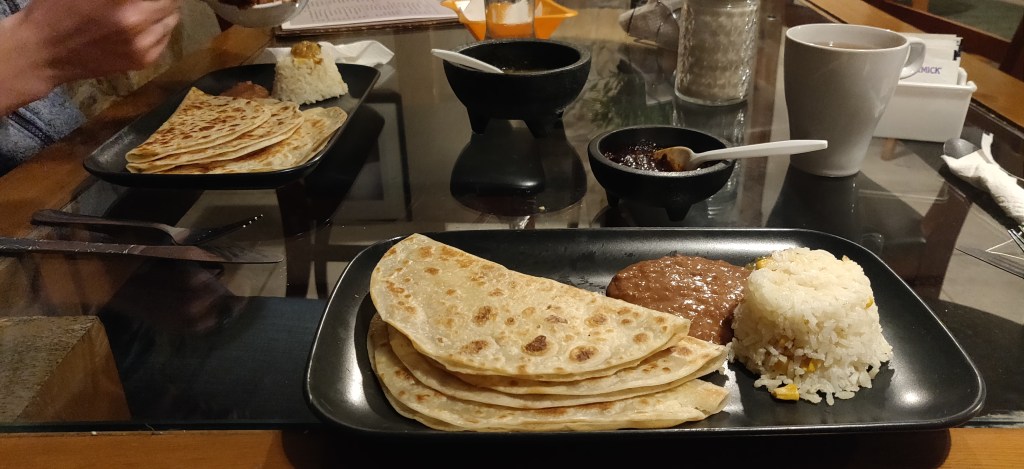
Edit: more about the food has been requested. It’s a big part of Mexico that I’d previously missed out – blame the driving fatigue. When we’ve eaten out, the food has been good and worth the price. Burritos are generally the order of the day, with frijoles (refried beans (though refried is a misnomer – refrito just means fried)) and rice and various things made of maize. They like their hot foot, and you almost always get hard tortillas and a spicy dip or two for free when you walk into the restaurant, like a Spanish tapas. We’ve not drunk alcohol out but they serve good fruit juices. We’re trying to buy cheap supermarket food to eat cold in order to save money, but it’s difficult here as most ready-to-eat food is crisps, fat, sugar, more fat and more sugar. There’s a traditional Mexican cheese called Oaxaca, which is a bit like mozzarella, but most cheese is like that in the USA – sliced and highly processed. The ‘chorizo’ is interesting – I’ve just used some for a pasta sauce. It’s just a paste/mince which you use to flavour things, rather than a hard sausage which they don’t really do here. Unfortunately we didn’t try the seafood by the coast, but the lobster from Guerrero Negro is meant to be some of the most expensive in the world, with a lot sold to the wealthy Chinese market.
End of edit.
 JH Woodcarving